In This Article
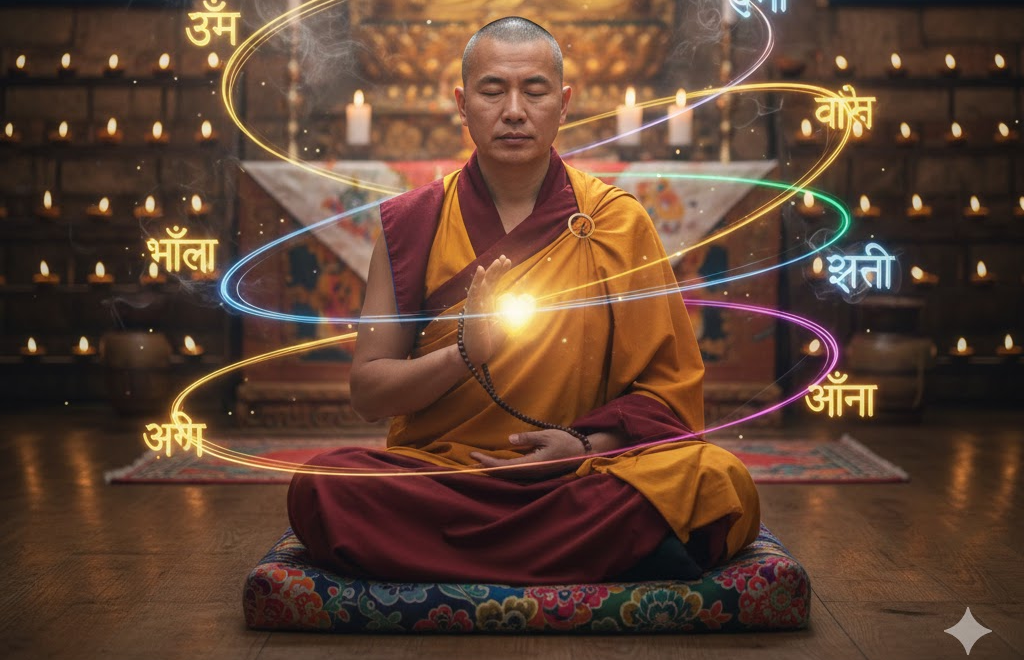
Mantra meditation is one of the oldest and most widely practised forms of Buddhist meditation. The word "mantra" comes from Sanskrit: "man" (mind) and "tra" (instrument) — a mantra is literally an instrument of the mind.
If you've found breath-focused meditation too subtle, or if your mind wanders relentlessly during silent practice, mantra meditation gives your brain something engaging to do. The rhythmic repetition of sacred syllables creates a focal point that's easier to maintain than the breath — like training wheels for attention.
What Is Mantra Meditation?
In mantra meditation, you repeat a specific word or phrase — either silently (most common), whispered, or aloud. The repetition serves multiple purposes:
- Concentration anchor — the mantra gives your mind something to hold onto, preventing wandering
- Vibrational quality — the specific sounds create physical vibrations in the body that practitioners find calming
- Meaning cultivation — mantras carry meaning (compassion, peace, wisdom) that subtly conditions the mind
- Rhythm — the repetitive rhythm induces a meditative state, similar to how a lullaby calms a child
Featured Mindfulness Tool: Official Mindful Gratitude Cards
Cultivate daily presence and quiet anxious thoughts with the official Mindful Gratitude Prompt Deck from Mindful.org. Features 50+ beautiful prompts designed by mindfulness teachers to anchor your mind in daily appreciation and calm.
Get Mindful Gratitude Cards Deck →Official Mindful.org Partner · Affiliate link
Try Our Free Racing Thoughts at Night Tool
Quiet racing thoughts with 4-2-6 breathing, a private brain dump, and calming bedtime audio. Runs 100% privately in your browser with zero sign-up.
Open Racing Thoughts at Night Tool →7 Buddhist Mantras and Their Meanings
1. Om Mani Padme Hum
Tradition: Tibetan Buddhism · Meaning: "The jewel in the lotus" — the mantra of compassion
The most famous Buddhist mantra, associated with Avalokiteshvara (Chenrezig in Tibetan), the bodhisattva of compassion. Reciting it is said to invoke compassion. Even secularly, the six syllables create a beautiful, calming rhythm.
How to say it: "Ohm Mah-nee Pahd-mey Hoom" — let each syllable flow into the next.
2. Om
Tradition: Universal (Buddhist, Hindu, Jain) · Meaning: The primordial sound
The simplest mantra. A single syllable that vibrates through the body. Excellent for beginners. Chant it aloud to feel the physical vibration, then shift to silent repetition once comfortable.
3. Buddho
Tradition: Thai Forest (Theravada) · Meaning: "Awakened one"
A simple, elegant mantra from the Thai Forest tradition. "Bud" on the inhale, "dho" on the exhale. Ajahn Chah and other Thai Forest masters taught this as a primary meditation technique.
4. Om Tare Tuttare Ture Soha
Tradition: Tibetan Buddhism · Meaning: Mantra of Tara, the female bodhisattva of compassion and protection
Used especially when facing fear, obstacles, or difficulty. The rhythm is uplifting and energising compared to the more solemn Om Mani Padme Hum.
5. Gate Gate Paragate Parasamgate Bodhi Svaha
Tradition: Mahayana Buddhism · Meaning: "Gone, gone, gone beyond, gone completely beyond — awakening!"
From the Heart Sutra, one of Buddhism's most important texts. This mantra celebrates the liberation found through insight into emptiness. It has an exuberant, joyful quality.
6. Namu Myoho Renge Kyo
Tradition: Nichiren Buddhism · Meaning: "Devotion to the wonderful law of the Lotus Sutra"
The primary practice of Nichiren Buddhism, chanted aloud with vigour. The practice is active and energising — the opposite of quiet contemplation. Popular worldwide through SGI (Soka Gakkai International).
7. So Hum
Tradition: Shared Buddhist/Hindu · Meaning: "I am that" — identifying with universal consciousness
"So" on the inhale, "Hum" on the exhale. Naturally mirrors the sound of breathing, making it feel effortless. Excellent for beginners and for bedtime practice.
How to Practise Mantra Meditation
Basic technique (15-20 minutes)
- Choose your mantra. For beginners: Om, Buddho, or So Hum. For compassion: Om Mani Padme Hum.
- Sit comfortably with a straight spine. Close your eyes.
- Take three settling breaths.
- Begin repeating your mantra silently. Let it find its own rhythm — don't force a pace. Some people synchronise with the breath; others let the mantra flow independently.
- When your mind wanders, gently return to the mantra. No judgement.
- Let the mantra become subtler over the session. It may become a whisper in the mind, then a faint echo, then just an intention. This deepening is natural — don't force it back to full volume.
- End by sitting in silence for 1-2 minutes after the mantra fades. Notice the quality of mind.
Three ways to recite
- Aloud (vaikhari) — spoken at normal volume. Best for beginners and for feeling the physical vibration. Good for group practice.
- Whispered (upamshu) — lips move but barely any sound. Transitional stage.
- Silent (manasika) — purely mental repetition. The most powerful and most common form. The mantra eventually becomes effortless background.
Best for Mantra: Insight Timer
Thousands of free mantra meditation sessions. Set a timer with traditional bells and chant at your own pace.
Try Insight Timer Free →Affiliate link — we earn a commission at no extra cost to you
Using Mala Beads
A mala is a string of 108 beads used to count mantra repetitions. It's the Buddhist equivalent of a rosary. Using a mala:
- Hold the mala in your right hand, draped over the middle finger.
- Use your thumb to pull each bead toward you after one mantra repetition.
- When you reach the guru bead (the large one), you've completed 108 repetitions. Don't cross over — turn the mala and go back the way you came.
- 108 repetitions of Om Mani Padme Hum takes approximately 12-15 minutes.
The physical act of moving beads gives your hands something to do (helpful for ADHD and restless types) and provides a tangible way to track your practice without watching a clock.
The Science of Mantra Meditation
- Research in the International Journal of Yoga found that mantra meditation reduced anxiety and depression scores by 30-40% over 12 weeks
- A study in Brain and Behaviour showed that mantra repetition decreased activity in the Default Mode Network — the brain's "wandering mind" centre
- Herbert Benson's research at Harvard demonstrated that mantra meditation elicits the "relaxation response" — reduced heart rate, blood pressure, and cortisol
- The vibration from chanting aloud stimulates the vagus nerve (via the larynx), activating the parasympathetic nervous system
Apps & Resources
| App | Mantra Content | Price | |
|---|---|---|---|
| Insight Timer | Free mantra sessions + customisable timer | Free | Try Free → |
| Waking Up | Mantra-based practices in Tibetan section | $99.99/yr | Try Free → |
| Calm | Chanting and mantra soundscapes | $69.99/yr | Try Free → |
Take Our Free Anxiety & Wellness Self-Assessment
Check your stress levels and get matched to the right relaxation exercises for your mood.
Start Free Assessment →FAQs
Does the meaning of the mantra matter?
Both meaning and sound contribute. Research shows that even meaningless syllables produce concentration benefits, but meaningful mantras add an emotional/intentional dimension.[1] Choose a mantra whose meaning resonates with you.
How is this different from Transcendental Meditation (TM)?
TM is a specific trademarked technique using personally assigned mantras. Buddhist mantra meditation uses traditional sacred syllables. The basic mechanism is similar — repetition as a concentration tool — but the philosophical frameworks and specific methods differ.
Can I make up my own mantra?
You can use any word or phrase as a concentration anchor (e.g., "peace," "let go," "present"). However, traditional mantras carry centuries of accumulated practice and meaning that personal phrases don't. Try a traditional mantra before creating your own.
Related Articles


Sources & References
- [1] Frontiers in Human Neuroscience / PubMed — Neurobiology of Buddhist Meditation and Focused Attention Practices
- [2] Springer / Mindfulness Journal — Theravada Mindfulness Practices (Anapanasati & Vipassana) in Modern Psychological Interventions
- [3] NCCIH (National Institutes of Health) — Meditation: In-Depth Overview
For general information only, not a substitute for professional medical care. In a crisis or severe symptom onset, consult a qualified healthcare provider immediately.