In This Article
Buddhist meditation is not about becoming Buddhist. It's about training your mind using techniques that have been refined for over 2,500 years — techniques that modern neuroscience is now confirming work exactly as ancient practitioners described.
If you've used Headspace, Calm, or any mindfulness app, you've already practised a simplified version of Buddhist meditation. But the original teachings go deeper, offering a systematic path to understanding your own mind, reducing suffering, and finding genuine peace.
This guide introduces the core Buddhist meditation practices in plain English — no jargon, no dogma, no requirement to adopt any beliefs.
What Is Buddhist Meditation?
Buddhist meditation refers to a family of mental training practices developed within the Buddhist tradition. The core insight is deceptively simple: most human suffering comes from the mind's habitual patterns — craving what we don't have, resisting what we do have, and misunderstanding the nature of our own experience.
Meditation addresses this directly by training three capacities:
- Samatha (calm abiding) — developing concentration and mental stability. Think of this as strengthening the "muscle" of attention so your mind can stay where you direct it.
- Vipassana (insight) — developing clear seeing into the nature of experience. Once concentration is stable, you use it like a microscope to examine how thoughts, emotions, and sensations actually work.
- Metta (loving-kindness) — developing warmth and compassion toward yourself and others. This counteracts the harshness and self-criticism that often accompany mental training.
Most modern mindfulness programmes draw primarily from vipassana, but all three work together. Concentration without insight becomes mere relaxation. Insight without compassion becomes cold analysis. Compassion without concentration lacks stability.
Featured Mindful.org Official Online Courses & Training
Deepen your daily Buddhist meditation and mindfulness practice with certified online courses led by world-renowned teachers at Mindful.org:


Official Mindful.org Partner · Self-Paced Online Training
Try Our Free 4-7-8 Breathing Exercise
Relaxing 4-7-8 breathing pacer for rapid relaxation. Runs 100% privately in your browser with zero sign-up.
Open 4-7-8 Breathing Exercise →Types of Buddhist Meditation
Vipassana (Insight Meditation)
The most widely practised Buddhist meditation in the West. You observe the breath, body sensations, thoughts, and emotions with bare attention — noticing what arises without reacting. Over time, you see firsthand that all experiences are impermanent, which naturally loosens the grip of anxiety, craving, and aversion.
Best for: Anxiety, self-awareness, understanding your own mind. The foundation for secular mindfulness.
Zen Meditation (Zazen)
The meditation practice of the Zen tradition. Characterised by strict posture (sitting upright on a cushion), minimal instruction ("just sit"), and extended silent practice. Zazen strips meditation down to its essence — you sit, you breathe, you face whatever arises.
Best for: People who prefer simplicity, discipline, and direct experience over guided instruction.
Loving-Kindness (Metta) Meditation
You silently repeat phrases of goodwill — "May I be happy, may I be peaceful, may I be free from suffering" — first toward yourself, then expanding outward to loved ones, neutral people, difficult people, and eventually all beings.
Best for: Self-criticism, depression, anger, relationship difficulties. Research shows it increases positive emotions and social connection.
Tibetan Meditation
A rich tradition including visualisation practices, mantra recitation, tonglen (giving and taking), and deity yoga. More elaborate than other Buddhist meditation forms, with extensive use of imagery and devotional elements.
Best for: People drawn to richly symbolic practices, visualisation, and the integration of compassion into daily life.
Walking Meditation
Slow, deliberate walking with full attention to each step. Practised in all Buddhist traditions, particularly Theravada and Zen. An excellent complement to sitting meditation and ideal for people who find stillness challenging.
Best for: Beginners, people with physical limitations, restless meditators, ADHD.
Mantra Meditation
Repetition of sacred phrases — "Om Mani Padme Hum," "Buddho," or others — as a concentration anchor. The rhythm and sound give the mind something engaging to focus on, making it more accessible than breath-only practices.
Best for: Overthinkers, people who find breath meditation too subtle, those seeking a devotional dimension.
How to Start Buddhist Meditation
Step 1: Choose one practice
Don't try everything at once. Start with vipassana (most versatile), metta (if you struggle with self-criticism), or zazen (if you prefer simplicity). You can explore other practices later.
Step 2: Start with 10 minutes
Traditional retreats involve hours of sitting, but that's not where you begin. 10 minutes daily is the minimum effective dose. Consistency matters more than duration — 10 minutes every day beats 60 minutes once a week.
Step 3: Use guidance initially
Although Buddhist meditation can be done in silence, beginners benefit enormously from guided instruction. Apps like Insight Timer (free), Waking Up (by Sam Harris — deeply rooted in Buddhist philosophy), and Headspace offer excellent guided Buddhist meditation sessions.
Step 4: Learn the basics of posture
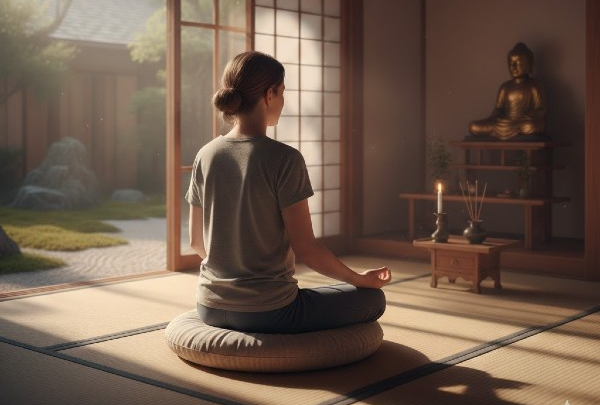
Sit with a straight spine (chair or cushion), hands resting on your thighs or in your lap, eyes either closed or softly gazing downward. The posture should be alert but relaxed — not rigid, not slouching. Zazen is particularly detailed about posture.
Step 5: Be patient with yourself
Your mind will wander constantly at first. This is completely normal and not a failure. The moment you notice your mind has wandered IS the practice — that's the "rep." Buddhist teachers say this returning is like building a muscle, and it's the most important part of meditation.
Looking for Personalized CBT Therapy & Mindfulness Coaching?
Self-guided Buddhist meditation is powerful, but combining mindfulness with professional CBT therapy offers long-term emotional recovery. Online-Therapy.com pairs you with a personal licensed therapist, CBT worksheets, and mindfulness tools from $48/week (20% off first month).
Get 20% Off Online Therapy →Affiliate link — we earn a commission at no extra cost to you
Your First Buddhist Meditation (10 Minutes)
- Sit comfortably with a straight back. Set a timer for 10 minutes.
- Take three deep breaths to settle. Then allow your breathing to return to its natural rhythm.
- Focus on the breath at the point where you feel it most clearly — nostrils, chest, or abdomen.
- When your mind wanders (it will, within seconds), gently notice where it went — "thinking," "planning," "worrying" — and return to the breath. No frustration needed.
- Repeat this process for 10 minutes. Each return to the breath is a successful moment of meditation.
- End with 30 seconds of metta: "May I be happy. May I be peaceful. May I be free from suffering."
That's it. You've just done authentic Buddhist meditation. Everything else is refinement and deepening of this core practice.
Common Misconceptions
"I need to empty my mind"
This is the biggest myth. Buddhist meditation doesn't require stopping thoughts — it requires changing your relationship with them. You observe thoughts rather than being carried away by them. Even experienced monks have busy minds; the difference is they don't engage every thought.
"I need to be Buddhist"
Buddhist meditation techniques work regardless of your beliefs. Millions of secular practitioners use these methods for stress reduction, mental clarity, and emotional wellbeing without any religious commitment.
"It takes years to see results"
Neuroscience research shows measurable changes in brain structure and function after just 8 weeks of regular practice.[1] Many people notice reduced anxiety and improved focus within days. The deeper insights do develop over time, but the practical benefits begin quickly.
"Meditation means escaping reality"
The opposite. Buddhist meditation trains you to see reality more clearly — to observe your actual experience rather than being lost in mental stories about it. It's arguably the most reality-facing practice available.
Best Apps for Buddhist Meditation
| App | Buddhist Content | Price | |
|---|---|---|---|
| Insight Timer | Largest free Buddhist library (10,000+ sessions) | Free | Try Free → |
| Waking Up | Deep vipassana, Dzogchen, and philosophy | $99.99/yr | Try Free → |
| Plum Village | Thich Nhat Hanh's teachings (free) | Free | Try Free → |
| Headspace | Secular mindfulness with Buddhist roots | $69.99/yr | Try Free → |
Take Our Free Anxiety & Wellness Self-Assessment
Check your stress levels and get matched to the right relaxation exercises for your mood.
Start Free Assessment →FAQs
Which type of Buddhist meditation is best for anxiety?
Vipassana is the most researched for anxiety. Metta is best if anxiety comes with harsh self-criticism. Many practitioners combine both — vipassana for awareness, metta for self-compassion.
Can I combine Buddhist meditation with therapy?
Absolutely — and it's often recommended. Many therapists incorporate mindfulness (from vipassana) into treatment. Online therapy alongside a daily meditation practice is a powerful combination.
How is Buddhist meditation different from Hindu meditation?
Buddhist meditation focuses on insight into impermanence and the nature of mind. Hindu meditation (like Transcendental Meditation) often uses mantras to achieve transcendence or union with the divine. In practice, there's significant overlap — the techniques are similar, but the philosophical frameworks differ.
Do I need a teacher?
For the basics, apps and books are sufficient. For deeper practice (particularly Zen and Tibetan traditions), a teacher becomes valuable. Many Buddhist centres offer free or donation-based instruction.
Related Articles


Sources & References
- [1] Frontiers in Human Neuroscience / PubMed — Neurobiology of Buddhist Meditation and Focused Attention Practices
- [2] Springer / Mindfulness Journal — Theravada Mindfulness Practices (Anapanasati & Vipassana) in Modern Psychological Interventions
- [3] NCCIH (National Institutes of Health) — Meditation: In-Depth Overview
For general information only, not a substitute for professional medical care. In a crisis or severe symptom onset, consult a qualified healthcare provider immediately.