When someone suggests meditation for depression, it can feel dismissive — as if sitting cross-legged will fix a neurochemical condition. The suggestion deserves scepticism. So let's look at what the evidence actually says, without overselling or underselling.
What Research Shows (The Good)
Mindfulness-Based Cognitive Therapy (MBCT) — an 8-week programme combining meditation with cognitive therapy — is now recommended by the NHS and NICE guidelines for preventing depression relapse.[1] Multiple large-scale trials found that MBCT reduces relapse risk by approximately 40-50% in people with three or more previous depressive episodes.
That's comparable to antidepressant medication for relapse prevention, which is why some guidelines suggest MBCT as an alternative to long-term medication for suitable patients.
For active depression, a meta-analysis of 18 randomised controlled trials found that mindfulness meditation produced moderate reductions in depressive symptoms — comparable to the effect size of cognitive behavioural therapy.
What Research Shows (The Limitations)
Meditation alone isn't enough for severe depression. If you can't get out of bed, lack the energy to shower, or have suicidal thoughts, meditation should supplement professional treatment — not replace it.
It can temporarily worsen symptoms. In approximately 8% of meditators, practice can increase anxiety, depersonalisation, or distressing thoughts — particularly during intensive practice. People with trauma history or active psychosis should work with a therapist-guided programme, not an app.
The studies have limitations. Many use small sample sizes, short follow-up periods, and self-report measures. The evidence is promising but not bulletproof.
How It Works (When It Works)
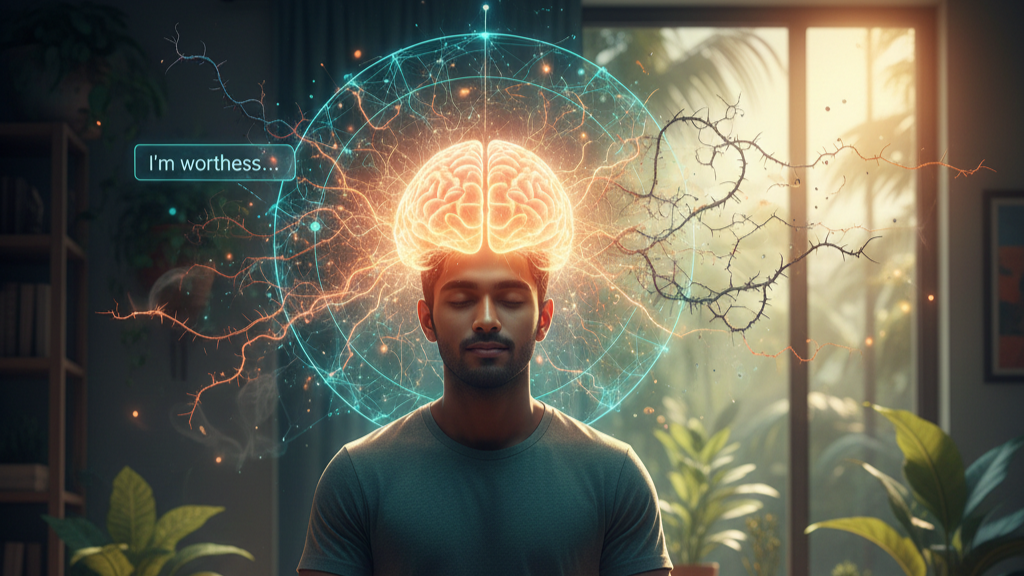
Depression involves a characteristic thought pattern: rumination. The same negative thoughts looping endlessly — 'I'm worthless,' 'nothing will change,' 'I always fail.' The brain gets stuck in the default mode network, replaying these narratives on autopilot.
Mindfulness doesn't eliminate these thoughts. It changes your relationship to them. Instead of 'I'm worthless' being an unquestioned fact, it becomes 'I'm having the thought that I'm worthless.' That tiny shift — from being the thought to observing the thought — creates space. In that space, the thought loses power.
A Practical Approach
If you're currently depressed: Don't try to meditate for 20 minutes. Start with 3 minutes of breath awareness. If that feels impossible, do 1 minute. If your mind attacks you with negative thoughts during practice, that's normal — it's what depressed brains do. Notice the thoughts, label them ('there's the worthless thought again'), and return to breathing.
If you're recovering: Consider a structured MBCT programme. These are available through the NHS, private therapists, and some online platforms. The combination of meditation and cognitive skills is more effective than meditation alone.
If you're preventing relapse: Daily meditation (10-15 minutes) is one of the most evidence-supported maintenance strategies available. It's particularly effective combined with regular exercise and social connection.
When to Seek Help Instead
Meditation is not appropriate as a sole intervention if you are experiencing suicidal thoughts, self-harm urges, inability to function daily, psychotic symptoms, or severe insomnia lasting more than two weeks. These require professional assessment. Your GP is the right starting point.
For general information only, not a substitute for professional medical care. In a crisis or severe symptom onset, consult a qualified healthcare provider immediately.