Kasina Meditation: Sri Lanka's Ancient Visual Concentration Technique
InnerCalmGuide·Feb 24, 2026·3 min read
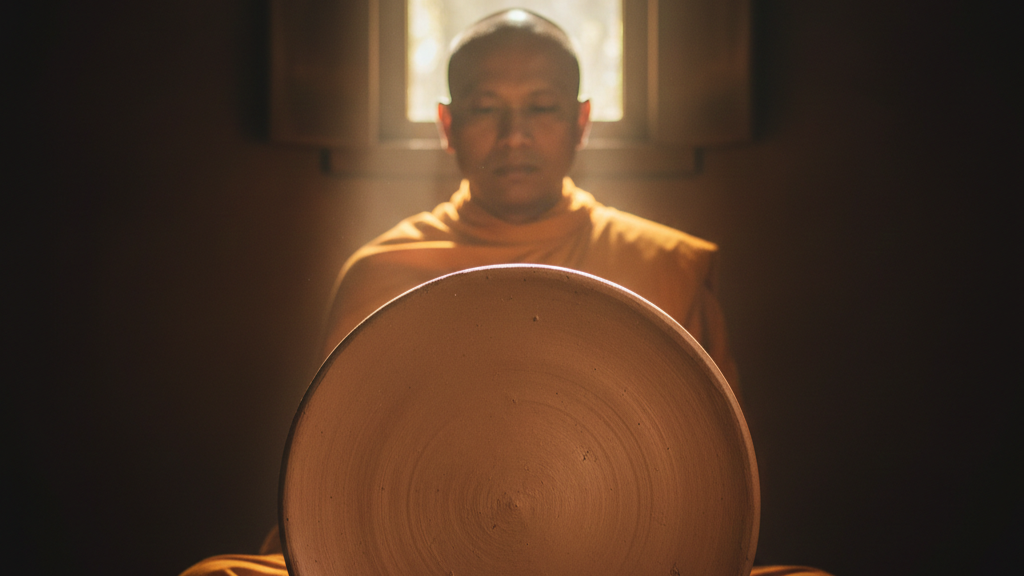
In Sri Lankan forest monasteries, you may encounter something strange: a monk staring intently at a small coloured disc mounted on a stand. This is kasina meditation — one of the oldest and most powerful concentration techniques in Buddhism, described by the Buddha himself and preserved in Sri Lankan Theravada practice for over two millennia.
What Is a Kasina?
A kasina is a meditation device — a circular disc (typically 25-30 cm diameter) of a single colour or element used as an object of visual concentration. The Visuddhimagga ('Path of Purification'), the 5th-century Sri Lankan meditation manual by Buddhaghosa, describes ten kasinas: earth (brown/ochre), water (clear), fire (red/flame), air (movement), blue, yellow, red, white, light, and space.
The most commonly practised in Sri Lankan centres are the colour kasinas — particularly white, blue, and red — and the earth kasina.
How It Works
Phase 1: Preparation
Create or obtain a kasina disc. For earth kasina: a circle of smooth clay, reddish-brown. For colour kasinas: a circle of pure, even colour on a neutral background. Place it at arm's length, eye level, in a well-lit but not glaring space.
Phase 2: Gazing (Uggaha Nimitta)
Sit comfortably. Gaze steadily at the kasina disc with relaxed, open eyes. Don't stare hard — soft focus. Study the disc: its colour, edges, texture. Continue for 15-20 minutes. When your eyes tire, close them briefly. You'll see an afterimage — a complementary colour version of the disc. This afterimage (uggaha nimitta) is the first milestone.
Phase 3: Mental Image (Patibhaga Nimitta)
With continued practice, the afterimage transforms. It becomes cleaner, brighter, and eventually appears as a pure, luminous disc that doesn't fade. This is the patibhaga nimitta — the 'counterpart sign' — a purely mental image that no longer depends on the physical disc. When this image is stable and bright, you can close your eyes and it remains.
Phase 4: Absorption (Jhana)
Fix your attention on the patibhaga nimitta. As concentration deepens, the nimitta may expand, brighten, or transform. When the mind fully absorbs into the nimitta, jhana arises. Kasina meditation is considered one of the most direct paths to jhana because the visual object is concrete and vivid — easier for the mind to grasp than the subtlety of breath.
Why Sri Lankan Masters Use Kasina
In the Sri Lankan Theravada tradition, kasina meditation is valued for several reasons. It develops jhana faster than breath meditation for visual learners. The visual nature makes progress measurable — you can clearly track the development from physical disc to afterimage to mental image to absorption. The technique develops powers of mental visualisation useful in advanced practices. And historically, kasina practice was associated with the development of psychic abilities (iddhi) described in the Pali texts.
Modern Applications
You don't need to believe in supernatural powers to benefit from kasina meditation. The concentration it develops is extraordinary — and concentration is the foundation for all other meditation benefits. If you've struggled with breath meditation because your mind wanders constantly, kasina gives your visual brain something concrete to hold onto.
Create a simple kasina: draw a blue circle (10 cm diameter) on white paper. Pin it at eye level. Practise for 15 minutes daily. Within 2-3 weeks, you should see the afterimage clearly with eyes closed. This is your first taste of the depth of concentration that Sri Lankan masters have developed over millennia.
For general information only, not a substitute for professional medical care. In a crisis or severe symptom onset, consult a qualified healthcare provider immediately.