Meditation Before Bed: A 10-Minute Routine for Deep Sleep
InnerCalmGuide·Feb 23, 2026·3 min read
The gap between 'exhausted' and 'asleep' can feel infinite. You lie there, tired but wired, while your brain decides now is the perfect time to review every mistake you've ever made. A bedtime meditation routine bridges that gap by systematically downshifting your nervous system from alert to asleep.
This 10-minute routine combines the three techniques with the strongest sleep research behind them: breath regulation, body scanning, and guided visualisation.
The Setup (1 minute)
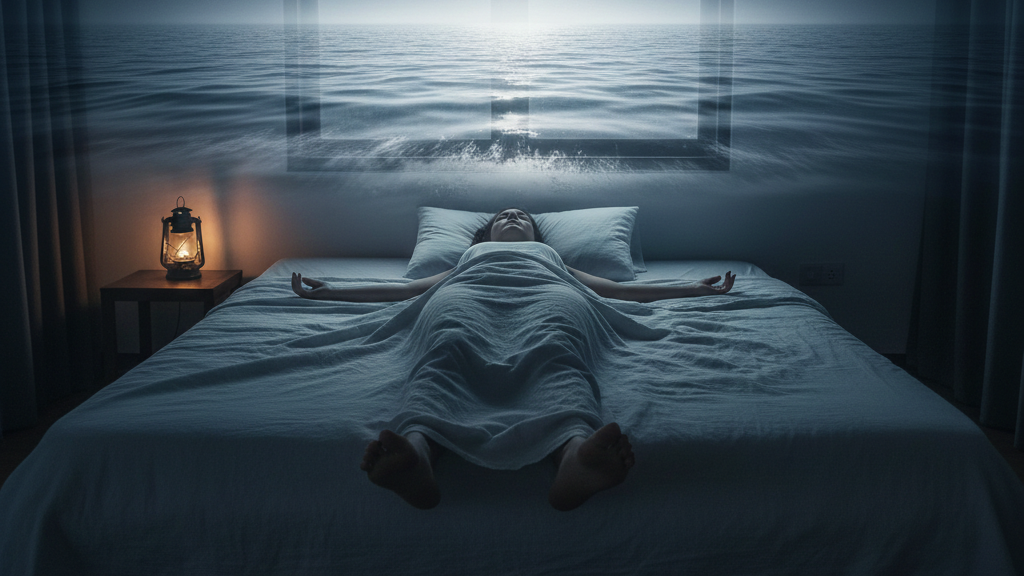
Lights off or very dim. Phone face-down or in another room. Temperature cool (16-19°C is optimal for sleep). Lie on your back with arms at sides, palms up. If you prefer your side, that's fine. Close your eyes.
Take 3 deep, audible sighs — breathe in through the nose, out through the mouth with a 'hahhh' sound. These sighs activate the parasympathetic nervous system faster than quiet breathing.
Phase 1: Extended Exhale Breathing (3 minutes)
Breathe in through your nose for 4 counts. Out through your nose for 8 counts. The exhale is twice the inhale — this ratio is key. Research from Stanford's Huberman Lab shows that extended exhales are the most efficient method for calming the autonomic nervous system.
If 4-8 feels too long, try 3-6. The ratio matters more than the duration. Continue for approximately 8-10 breath cycles (3 minutes).
By the end of this phase, your heart rate should have noticeably slowed.
Phase 2: Sleep Body Scan (4 minutes)
Let your breathing return to natural. Now bring attention to your feet. Feel their weight. Feel the temperature of the sheets against them. Imagine them becoming incredibly heavy — sinking into the mattress.
Move to your lower legs. Same process — notice, feel heavy, sink. Continue upward: thighs, hips, lower back, stomach, chest, arms, hands, shoulders, neck, jaw (let it fall open slightly), eyes (let them rest deep in their sockets), forehead (smooth every muscle).
The key instruction at each body part: let it be heavy. Heaviness is the physical sensation of relaxation, and deliberately inviting it accelerates the process. Most people notice their body feels 2-3 times heavier by the end of the scan — a sign the muscles have genuinely released.
Phase 3: Sleep Visualisation (2 minutes)
Choose one of these scenes and build it in detail:
Warm beach: You're lying on warm sand. Waves rhythmically wash in and pull out. Each wave that retreats takes a thought with it. Sun warms your skin. Nothing to do. Nowhere to be.
Mountain cabin: Snow falling outside a window. Fire crackling. Heavy blanket over you. Complete silence except for the fire and occasional wind. Total safety. Total warmth.
Floating: You're floating on still, warm water. Stars above. Complete silence. The water supports you completely. You don't need to do anything to stay afloat. Just rest.
Pick one scene and commit to it each night. Over time, your brain associates that specific visualisation with sleep onset — creating a Pavlovian trigger that makes falling asleep faster each time you use it.
What If It Doesn't Work?
If you're still awake after 10 minutes, don't panic. Don't look at the clock. Repeat the body scan from your feet. Most people fall asleep during the second pass. If you're consistently unable to sleep after 20+ minutes, get up, go to a different room, do something quiet (reading, gentle stretching), and return to bed when drowsy.
This routine works best with consistency. Your brain needs 1-2 weeks to learn the association between this routine and sleep. By week 3, most people report falling asleep before completing the visualisation phase.
For general information only, not a substitute for professional medical care. In a crisis or severe symptom onset, consult a qualified healthcare provider immediately.