Anapanasati: The Buddha's Original Breathing Meditation
InnerCalmGuide·Feb 23, 2026·3 min read
Every meditation app's breath focus exercise traces back to a single source: the Anapanasati Sutta — the Buddha's discourse on mindfulness of breathing, preserved in the Pali Canon and continuously practised in Sri Lanka for over two millennia.
Anapanasati (Pali: ana = in-breath, pana = out-breath, sati = mindfulness) is both the simplest and most profound meditation technique in existence. It begins with noticing your breath and, practised deeply, leads to complete liberation. The same technique serves a beginner's first session and a master's final insight.
The Original Instructions
The Anapanasati Sutta outlines 16 steps organised in four groups of four (tetrads). Most modern breath meditation teaches only the first few steps. Here is the complete framework as preserved in Sri Lankan Theravada tradition:
First Tetrad: Body (Kaya)
1. Breathing long: When breathing in long, one knows 'I breathe in long.' When breathing out long, one knows 'I breathe out long.' Simply recognise the quality of each breath without changing it.
2. Breathing short: When breathing in short, one knows 'I breathe in short.' As concentration develops, the breath naturally shortens and becomes more subtle. Notice this change.
3. Experiencing the whole body: One breathes in experiencing the whole body. Awareness expands from the nose to the entire breathing process — the rise of the chest, expansion of the ribs, movement of the diaphragm. The whole body becomes the field of awareness.
4. Calming the body: One breathes in calming the body formation. As attention stabilises, physical tension naturally releases. The body becomes still and peaceful. The breath becomes very fine — almost imperceptible.
Second Tetrad: Feelings (Vedana)
5. Experiencing joy (piti): As concentration deepens, a natural joy arises — not excitement, but a quiet, pervasive happiness. This is piti, the rapture that accompanies deepening meditation.
6. Experiencing pleasure (sukha): Deeper than joy, sukha is a bodily pleasure — warmth, ease, contentment. In jhana practice, this corresponds to the first and second absorptions.
7. Experiencing mental formations: Awareness of the mind's activity itself — noticing how thoughts and emotions arise as formations, not as 'you.'
8. Calming mental formations: As with the body, the mind's activity naturally calms. Thoughts become infrequent. The mind settles into clarity.
Third Tetrad: Mind (Citta)
9-12: Experiencing, gladdening, concentrating, and liberating the mind. These steps develop deep samadhi (concentration) and begin the transition from calm to insight.
Fourth Tetrad: Dhamma (Truth)
13-16: Contemplating impermanence, dispassion, cessation, and relinquishment. These final steps are the vipassana (insight) dimension — using the concentrated mind to see the true nature of reality.
How It's Practised in Sri Lanka
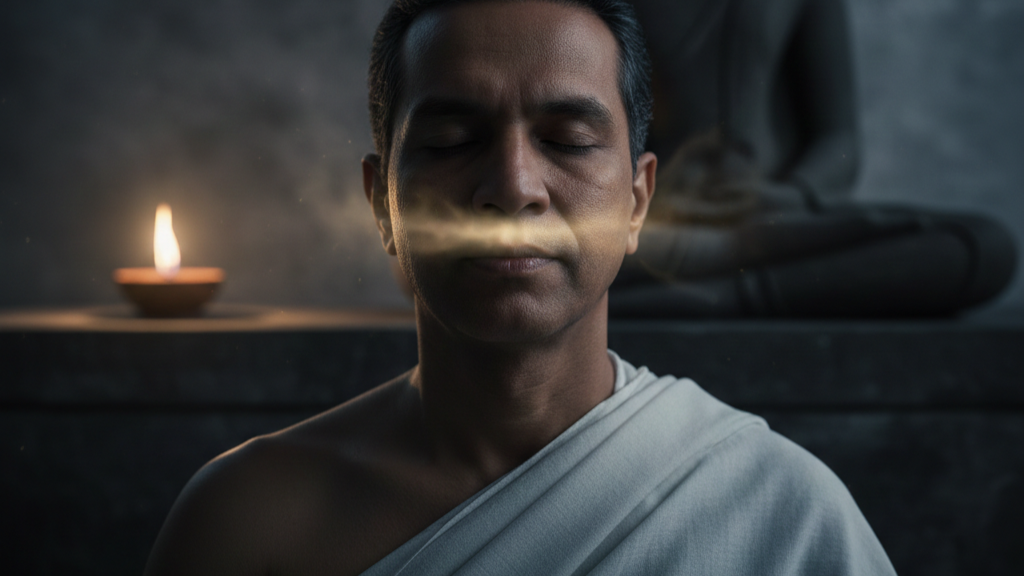
In Sri Lankan meditation centres, anapanasati is taught progressively. Beginners work with steps 1-4 for weeks or months. The breath is observed at the nostrils — the spot where air first touches on the way in and last touches on the way out. This point (called the parimukha) becomes the fixed location of attention.
Unlike some traditions that follow the breath through the body, the Sri Lankan method keeps attention at this single point. The breath comes to you — you don't chase it. This develops a precise, concentrated awareness that facilitates the deeper stages.
How to Start
Sit comfortably. Close your eyes. Breathe naturally — don't control the breath. Bring attention to the tip of your nostrils or your upper lip, where you feel the breath most clearly. Notice each inhale and exhale at this point. When the mind wanders, return to this point. That's step 1.
This is simultaneously the beginning of meditation and the doorway to its deepest states. Every breath you observe is exactly the practice the Buddha described.
For general information only, not a substitute for professional medical care. In a crisis or severe symptom onset, consult a qualified healthcare provider immediately.