Buddhist Meditation in Sri Lanka: The World's Oldest Living Tradition
InnerCalmGuide·Feb 23, 2026·3 min read
When Ashoka's son Mahinda brought Buddhism to Sri Lanka in 247 BCE, he didn't just bring a religion. He brought a complete meditation system — one that Sri Lanka has preserved, practised, and protected for over 2,300 unbroken years. While Buddhism evolved, split, and transformed across Asia, Sri Lanka maintained Theravada Buddhism in its most original form.
This matters for meditation practitioners because Sri Lankan Buddhist meditation isn't a modern interpretation. It's the closest living link to how the Buddha himself taught meditation.
Why Sri Lanka Is Different
Theravada purity: Sri Lanka follows Theravada Buddhism — the 'Teaching of the Elders' — the oldest surviving Buddhist school. The Pali Canon (Tipitaka), preserved in Sri Lanka since the 1st century BCE, contains the original meditation instructions attributed to the Buddha. When you learn meditation in Sri Lanka, the instructions trace directly back to these 2,000+ year-old texts.
Living lineage: Sri Lankan meditation masters maintain teacher-student lineages stretching back centuries. The techniques haven't been reconstructed from books — they've been transmitted person-to-person through continuous practice. This living transmission carries subtle knowledge that written instructions cannot capture.
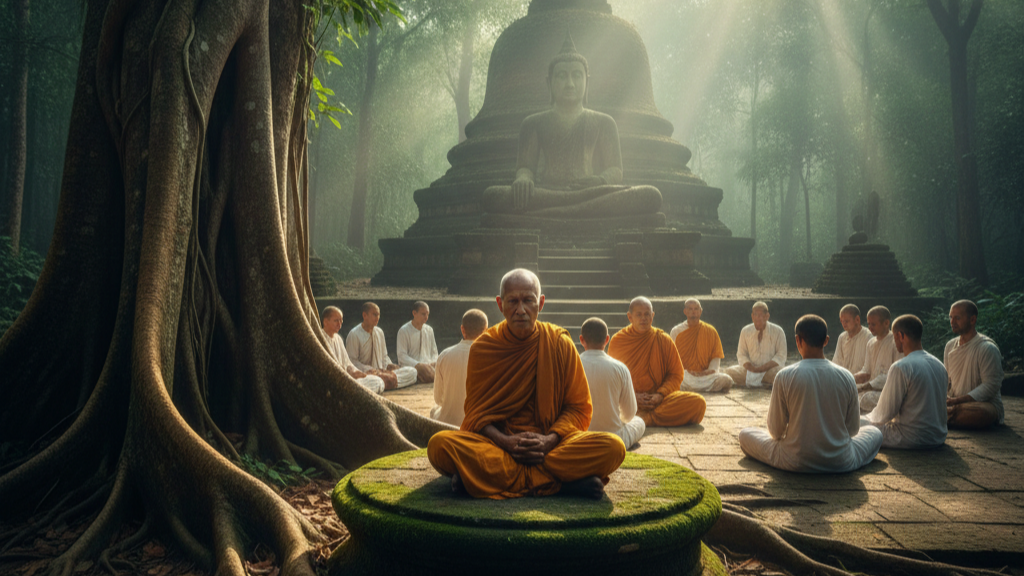
Forest monastery tradition: Sri Lanka's forest monasteries (aranya) provide environments specifically designed for deep meditation. Monks live in simple kutis (huts) in the jungle, following the same lifestyle the Buddha recommended: minimal possessions, natural surroundings, and uninterrupted practice time.
Integration with daily life: Unlike countries where Buddhism became primarily ceremonial, Sri Lankan Buddhism maintains active meditation practice among laypeople. Visit any temple at dawn and you'll find ordinary Sri Lankans — office workers, farmers, teachers — meditating before their day begins.
The Two Main Meditation Paths
Sri Lankan Buddhist meditation follows the Buddha's original framework of two complementary practices:
Samatha (Calm Abiding)
Samatha meditation develops deep concentration (samadhi) by focusing the mind on a single object — usually the breath (anapanasati), a kasina disc (coloured circle), or a quality like loving-kindness (metta). The goal is jhana — states of profound absorption where the mind becomes completely unified with its object.
Sri Lankan samatha practice is distinctive for its emphasis on the jhanas as actual attainable states, not just theoretical concepts. Masters in the Sri Lankan tradition guide students through progressive jhana levels with specificity rarely found elsewhere.
Vipassana (Insight)
Vipassana develops direct experiential understanding of the three characteristics of existence: impermanence (anicca), suffering (dukkha), and non-self (anatta). Through systematic observation of bodily sensations, thoughts, and emotions, practitioners develop insight that leads to liberation.
Sri Lankan vipassana differs from the Burmese-derived Goenka tradition (which most Westerners encounter first). The Sri Lankan approach, rooted in the Satipatthana Sutta, often combines vipassana with samatha rather than treating them as separate paths. Concentration and insight develop together.
Key Meditation Centres
Sri Lanka has hundreds of meditation centres, from jungle hermitages to structured retreat facilities. The most significant include Kanduboda Meditation Centre (Delgoda), Nilambe Meditation Centre (Kandy), Lewella Meditation Centre (Kandy), Mitirigala Nissarana Vanaya (forest monastery near Colombo), and Rockhall Meditation Centre (Bandarawela).
For International Visitors
Most Sri Lankan meditation centres welcome international visitors. Many offer programmes in English. Costs are typically donation-based (dana) — you pay what you can, and nothing if you can't. This isn't a marketing tactic; it's a fundamental Buddhist principle that the teachings should be freely available to all.
The best time for meditation retreats is the dry season (December-April). However, the rainy season retreats (vassa) hold special significance — monks traditionally enter intensive practice periods during the monsoon.
For general information only, not a substitute for professional medical care. In a crisis or severe symptom onset, consult a qualified healthcare provider immediately.