Guided vs Unguided Meditation: Which Is Better for You?
InnerCalmGuide·Feb 23, 2026·3 min read
Every meditation app assumes you want guided meditation. Every meditation purist tells you silence is superior. They're both partly right. The real answer depends on your experience level, your goals, and what's happening in your brain on any given day.
What's the Actual Difference?
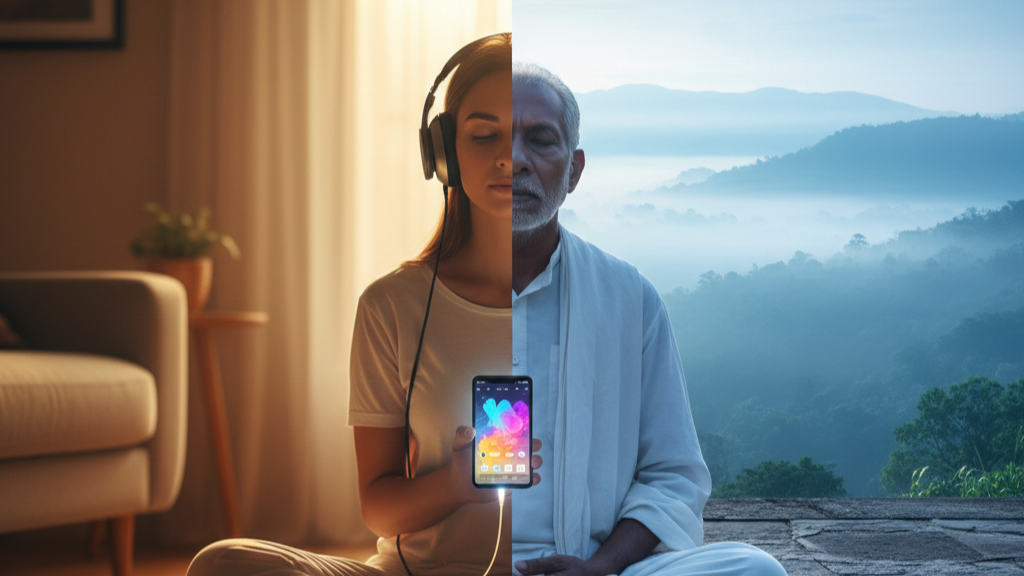
Guided meditation: A voice (live teacher or recording) tells you what to do — where to put your attention, when to breathe, what to visualise. You follow instructions. Your brain has a task.
Unguided meditation: Silence. You sit, choose a technique (breath focus, mantra, open awareness), and practise alone. No instructions, no voice, no app. Just you and your mind.
When Guided Is Better
You're a beginner: Without guidance, most beginners sit down, close their eyes, and immediately think 'now what?' followed by 10 minutes of confused fidgeting. Guided meditation eliminates this barrier — someone tells you exactly what to do.
You're learning a new technique: Body scan, loving-kindness, visualisation, and Yoga Nidra all have specific structures that are easier to learn from a guide than from memory.
Your mind is very busy: On high-anxiety or high-stress days, silence can amplify mental noise rather than quiet it. A guide's voice gives your brain an external anchor that's easier to hold than internal breath awareness.
You need specific help: Guided meditations for sleep, anxiety, pain, or grief are designed with those conditions in mind. The guidance includes psychologically informed language that addresses your specific state.
When Unguided Is Better
You're experienced: After months of guided practice, the instructions become repetitive. You know the technique — you don't need someone telling you to 'notice your breath' for the hundredth time. Silence lets you go deeper without a voice pulling you back to surface-level instruction.
You want deeper states: Guided meditation keeps you in a responsive, listening state. Truly deep meditation — flow states, absorption, insight — requires uninterrupted internal focus. The guide's voice, however gentle, prevents the deepest settling.
You want independence: Relying on an app means you can't meditate without your phone. Unguided practice means you can meditate anywhere — waiting room, park bench, flight — without technology.
You want to understand your own mind: Guided meditation directs your experience. Unguided meditation reveals your natural mental patterns — where your mind goes when left alone, what emotions surface without distraction, what your baseline state actually is.
The Transition Path
Months 1-3: Guided meditation daily. Learn techniques, build the habit, establish a foundation. Use apps (Headspace, Calm, Insight Timer) or YouTube.
Months 3-6: Alternate guided and unguided. Some days use an app, other days set a timer and practise alone. Notice which days you need guidance and which you don't.
Months 6+: Primarily unguided with guided sessions for specific needs (new technique, difficult day, sleep assistance). Your daily practice is self-directed; apps become tools rather than crutches.
The Best Approach
Use guided meditation to learn and unguided meditation to grow. Think of guided sessions as lessons and unguided sessions as practice. A piano student needs a teacher, but they also need to play alone. Both are essential.
For general information only, not a substitute for professional medical care. In a crisis or severe symptom onset, consult a qualified healthcare provider immediately.