Walking Meditation in Sri Lankan Monasteries: A Step-by-Step Guide
InnerCalmGuide·Feb 23, 2026·3 min read
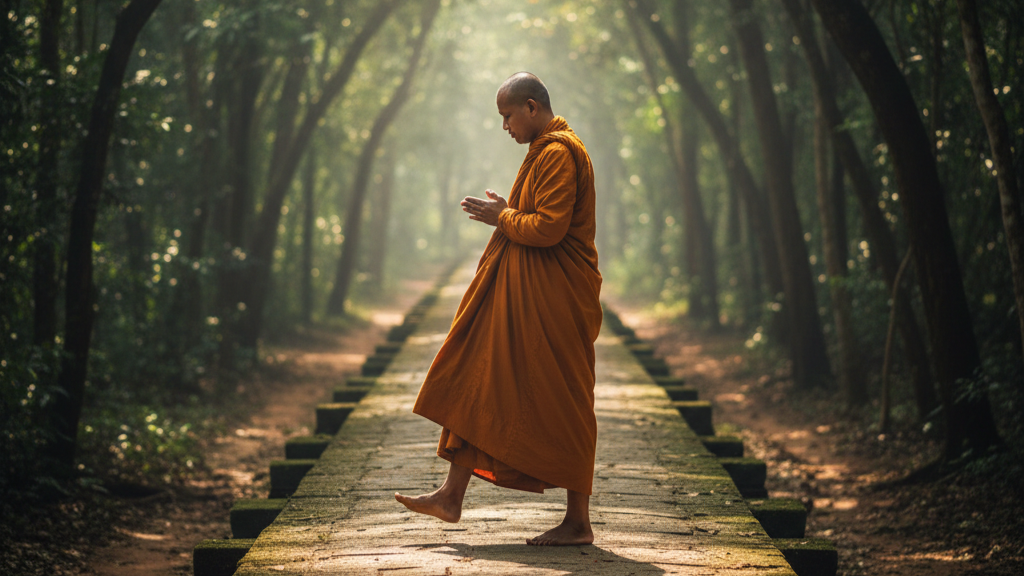
Walk into any Sri Lankan forest monastery and you'll see something Western meditation culture largely ignores: monks spending equal time in walking meditation (cankama) as in sitting meditation. In the Theravada tradition, cankama isn't a casual supplement to 'real' meditation — it's a core practice with its own depth and its own path to insight.
'
Why Walking Meditation Matters
The Buddha explicitly recommended alternating sitting and walking meditation. The Pali texts describe him walking the cankama (a designated walking path, typically 30-60 paces long) for hours. The reason is practical: sitting meditation develops deep concentration but can lead to drowsiness and physical stiffness. Walking meditation maintains alertness, develops mindfulness during movement, and exercises the body while training the mind.
In Sri Lankan monasteries, the daily schedule alternates: one hour sitting, one hour walking, throughout the day. This rhythm sustains continuous mindfulness without the fatigue that extended sitting creates.
The Technique (Sri Lankan Theravada Method)
The Path
Choose a straight, flat path approximately 20-30 paces long. In Sri Lankan monasteries, these paths (cankamana) are often covered walkways — stone or concrete strips shaded by trees. At home, a hallway, garden path, or any clear space works.
The Posture
Stand at one end. Hands clasped gently in front (right hand holding left wrist) or behind your back. Eyes open, gaze lowered to the ground about 2 metres ahead. Don't look at your feet — peripheral vision is sufficient. Body upright but relaxed.
Level 1: Simple Noting (Beginners)
Walk at a slow, natural pace. With each step, mentally note: 'left, right, left, right.' When you reach the end of the path, stop. Note 'standing, standing.' Turn slowly. Note 'turning, turning.' Walk back. That's it.
This level develops basic mindfulness of movement. Practise for 1-2 weeks before progressing.
Level 2: Three-Part Step
Slow down further. Break each step into three phases: 'lifting' (foot lifts from ground), 'moving' (foot moves forward through air), 'placing' (foot touches ground). Note each phase silently. The pace becomes very slow — one step every 2-3 seconds.
This level develops detailed awareness of the physical process of movement. You begin to notice that what you call 'a step' is actually a complex sequence of sensations.
Level 3: Six-Part Step (Advanced)
Break each step into six phases: 'intending' (the mental intention before movement), 'lifting,' 'raising,' 'moving,' 'lowering,' 'placing.' Each phase is noted separately. The pace is extremely slow — one step may take 5-8 seconds.
At this level, you begin to see the relationship between intention and action — the mind's command and the body's response. This is where vipassana insight begins to arise during walking practice.
Common Experiences
Impatience: Walking this slowly feels absurd at first. The restlessness is itself the practice — noticing the mind's resistance to slowness reveals how addicted it is to speed and stimulation.
Tingling or heat in the feet: Increased attention to the feet often produces heightened sensation. This is normal and a sign of developing body awareness.
Stability after walking: Many practitioners find that sitting meditation immediately after walking meditation is deeper and more stable. The walking has settled restlessness while maintaining alertness — ideal conditions for concentration.
Walking Meditation in Daily Life
You don't need a monastery path. Walk to the train station mindfully. Walk between meetings mindfully. Walk from your car to your front door with attention on each step. Any walking can become meditation — the Sri Lankan tradition simply formalises what is available in every step you take.
For general information only, not a substitute for professional medical care. In a crisis or severe symptom onset, consult a qualified healthcare provider immediately.